• Bio
  • Contact
  • Events and Resources
  • My Writing

Jessica Jonas

Jessica Jonas

Category Archives: Books

Bossypants

07 Wednesday Mar 2012

Posted by jessicamjonas in Books, Reading, Reviews

≈ 2 Comments

Tags

bossypants, tina fey, what I'm reading

I fell right off the edge of the world for a while there, didn’t I? It’s been a busy stretch (and midterms hasn’t even hit yet, Lord help me). Anyway, I am ducking in to do more than announce that I am still alive: I have just finally now gotten around to reading Bossypants, by Tina Fey, and if you have not, it is time you did too, especially if you are too busy to read anything.

Bossypants is, largely, a memoir of the development of a comedian and lady boss who is (just a little) frustrated sometimes that people are still shocked that a woman can be in charge of something that is not the kitchen. It is gaspingly funny. Some favorite moments for me include the time in college she hiked a mountain in hopes of some light fondling and maybe some dry humping her partner at the top, the crappy receptionist job where her only joy was passive-aggressively cutting the unlock-door buzzer off too short so people would still be locked out when they pushed the door handle, and anything involving her dad.

Tina Fey, for those of you who (like me) climbed out from under your rock this morning and said, “Wait–she was the one who was Sarah Palin that one time, right?” manages to be bright and attractive and still take unabashed delight in being awkward. She’s the ugly duckling who grew up and then decided being the duckling was more interesting, anyway.

At any rate, I laughed a lot even though anytime I looked away from the book, I was stunned by how much homework I had left to do. Speaking of, I need to go read stories thoughtfully and slice fancy art-store paper into 5.5 x 7.75 pieces for my midterm book, but I will be back soon!

Reading for Writers

13 Monday Feb 2012

Posted by jessicamjonas in Books, Writing

≈ 10 Comments

Tags

dorothea brande, inspiration, natalie goldberg, peter bowerman, william zinsser, writing, writing life

A friend of mine contacted me the other day because she’s interested in getting into writing more seriously and wanted to talk about how to get started. It was wonderful because it’s always an ego boost when people think you’re good enough at something to ask for your thoughts, and because having lunch with a friend and talking about books and writing sounds like an ideal way to spend a few hours of a Saturday afternoon.

I was putting together some recommendations, books and blogs and magazines that have helped shape my understanding of what being a writer means, so it only seems fair that I would share them here:

The Books

  1. On Writing Well, by William Zinsser. One of those perfect books on structure and craft. His focus on clarity, strength, and confidence in writing is as applicable to poetry as nonfiction, copywriting, blogging, or novels.
  2. Becoming a Writer, by Dorothea Brande. An oldie, originally published in 1934. This book addresses “personality problems” like writer’s block, how to balance reading well and writing well, developing a writing schedule, and so forth.
  3. Bird by Bird by Anne Lamott and Writing Down the Bones, by Natalie Goldberg. A Zen follower and poet, Goldberg is a legendary writing guru. Her writing philosophy combines deep introspection and moment-by-moment awareness in a writing style that feels to me like creative meditation. Anne Lamott’s book is named after a memory of her brother panicking at the thought of tackling an overwhelming ornithological project. Her father’s advice, “Just take it bird by bird, buddy,” is perfect for novelists working to break past the “Chapter 1–now what?” hurdle.
  4. The Well-Fed Writer, by Peter Bowerman. Because being a starving writer in a garret isn’t half as romantic as it seems (and it doesn’t even seem that romantic). Bowerman delivers practical tips for starting and running a lucrative freelance writing biz. His lively, engaging voice is like having a session with a career coach, no-nonsense and encouraging at the same time.

The Magazines

  1. Poets & Writers (more literary)
  2. Writer’s Digest (more commercial/consumer magazine)
  3. The Writer (excellent for beginners, has the most articles on developing writing skill)

The Blogs

  1. Carol Tice’s http://www.makealivingwriting.com (freelance how-tos)
  2. Ali Luke’s http://www.aliventures.com (fiction and creating a strong blog platform)
  3. Copyblogger’s http://www.copyblogger.com/blog (copywriting and blogging)

Which writing books, blogs, and magazines do you find most helpful?

How to Make a Magic Book

10 Friday Feb 2012

Posted by jessicamjonas in Books, Crafts

≈ 1 Comment

Tags

books, class, lit pub, magic book, making books

The Publishing Fetish

09 Thursday Feb 2012

Posted by jessicamjonas in Books, Reading, Writing

≈ Leave a comment

Tags

italo calvino, lightness, publishing, quickness, six memos, writing

“The demands of the publishing business are a fetish that must not be allowed to keep us from trying out new forms.”

The quote comes from Italo Calvino’s Six Memos. I’m reading two of them this week, “Lightness” and “Quickness,” and they are both gorgeous explorations of qualities of literature and writing that Calvino enjoys, or notices in himself, or wants to develop more. Neither term is as simple or frivolous as it may seem on first glance, and I’d like to get into Calvino’s ideas a little bit more, but first we need to talk about that quote, because it’s incredibly important.

As people keep explaining, the emergence of e-publishing and the traction it has gained in the last several years marks a kind of revolution in the relationship between writing and publishing that we haven’t seen in decades, if ever. In a time where only a tiny percentage of literary journals pay for stories and poems, only a fraction of consumer magazines publish literature, and traditional publishing seems more and more steeped in bureaucracy, the fact that writers are able to publish their work independently, and to do so with decreasing stigma, is a wonderful movement toward the empowerment of literary thought and talent.

What it is key to remember, though, is that independent publishing is still, ultimately, part of the publishing business. I say this because if a writer publishes traditionally and is discouraged from breaking out of his or her genre, or trying a new form, it’s fairly clear that whether the publisher or agent or whoever is to blame for imposing restrictions. If a writer is working independently, it’s going to be harder to tell whether reluctance to try a new thing, or pressure to do one particular thing, is in response to the writer’s own voice or his or her perceived publishing rules.

We are exploring a new publishing frontier, and as with any unsettled space, what we will find is what we bring with us. We can make a world with the same shelves and distinctions, or we can reinvent them. Length doesn’t matter anymore—without the dependence on paper signatures or the need for a hardback book to meet a certain length in order to balance text and cover, we can see more novellas, or short stories published as singles—or even epics that would have been too much for a spine to handle. When you don’t have the barrier of a magazine’s or publishing house’s reputation to consider, we could have more experimental fiction. We could see a writer publishing the bizarre along with the traditional as versatile, not uneven.

Many writers are undoubtedly already taking this philosophy to heart without needing me or Calvino or anyone else to remind them. I’ve been noticing a number of online literary magazines asking specifically for the experimental and new. For a lot of us, though, myself included, it’s still so easy to get wrapped up in the publishing fetish (Calvino’s choice of word there is perfect), and it’s important to get the reminder that if we think we can do something well, sooner or later, there will be a need and an audience for our kind of writing.

Coming Home to Books

31 Tuesday Jan 2012

Posted by jessicamjonas in Books

≈ 7 Comments

Tags

beatrice coron, books, inspiration, jenny o'grady, school

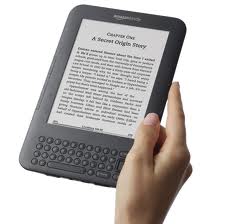
If you follow the idea of an e-book revolution through to the end, it’s possible to imagine a house where this is the bookshelf:

My New Yorkers are in a virtual pile now

Even though I love my Kindle (and really need to read those New Yorkers one of these days), the thought of only having an e-reader for my book collection makes me uneasy. Like many book-lovers, I’m attached to the physical form, and I’ve often had a hard time explaining it. Once someone tells you they don’t find the smell of musty paper and glue delectable, your main card’s played, right?

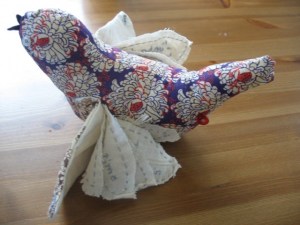
Enter Literary Publications, one of my classes this semester. We are focusing on books that are so beautiful that they become a work of art in and of themselves–and we’ll be learning to make our own! For a taste, here’s a book the professor made that she brought in to show us:

A very unusual book made by Jenny O'Grady. Love the wing "pages."

The wings have poems sewn into them about migration–one wing for the trip north, and the other for the trip south.

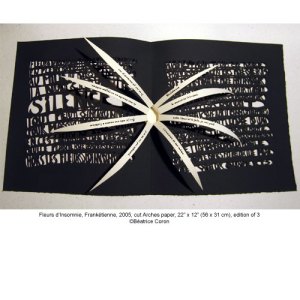
The idea of homing in on books is a happy one. In my apartment, my TV shelf has all kinds of cubbies in it for knickknacks or DVDs. Most of the cubbies have at least one book–paperback dystopian novels, the lovely green fabric-bound photo album that holds my trips to Nain and Spain, and writing books. My bedroom holds my poetry collection (2 dozen books and counting), picture books from my childhood, old copies of Jane Eyre or The Pickwick Papers, short story collections bought on a whim, and a teetering stack of library books by my bed. What I can’t wait to do is add my own creations to this collection, books that are as sculptural as literary. Check this out:

Fleur, by the amazing Beatrice Coron

The assignment this week? Make a “magic book.” Looking at book artists like Beatrice Coron, Laura Davidson, Susan Kapuscinski Gaylord, and Dineke McLean, I’m wondering if there’s anything but.

Poke the Box

06 Friday Jan 2012

Posted by jessicamjonas in Books, Goals

≈ Leave a comment

Tags

goals, ideas, inspiration, poke the box, seth godin, what I'm reading

The first week of 2012 is over, and I’m already glancing behind me to make sure I hit my resolutions (almost all of mine are incremental, do-this-x-times-per week things, which is good because baby steps, but it means I have to hold myself accountable all the time). Did I meet my gym goals? Cook enough new recipes? Spend enough time writing? Make time to see my friends? The answer’s yes, fortunately–the first week of a new year does wonders for discipline and optimism–but what if I didn’t look at my resolutions as a list of categories and boxes to check off? From what I can see, most resolutions boil down to a promise to start things.

Enter Seth Godin and his manifesto, Poke the Box. Godin’s main point in this book is that, while we may be talented in a variety of ways, one skill that never seems to be actively taught or even encouraged is that of initiating. It’s a pretty glaring omission, when you think about it. Without having the chutzpah to try something new, nothing would ever get invented, even in a room full of the brightest and most creative people around. Unfortunately, in many schools and workplaces, people fall back on safe and familiar. Godin urges the reader to commit to making initiative a way of life.

It’s a cool read. The book is slim and broken into neat mini-sections, so it would be easy to polish off in an hour, tops, but I’d suggest you don’t do that. Spacing it out will give you some time to percolate over things like the lizard brain (the fight-or-flight instinct that fears change), how to embrace things like risk and failure, and why you might be morally obligated to be as creative as possible. The book contains few, if any, how-to instructions. Godin’s whole point is that we need to be the mapmakers, not another handful of tourists looking for a route to follow. But even without concrete tips, the book has punch, and left me with a new sense of energy toward my job and writing.

It’s a new year, and you’re probably already charged to make it as great as possible. But maybe it’s a mistake to limit that resolve to things like, “eat healthier food,” or “reduce smoking by 50%.” Maybe it’s time for bigger adventures, and for making inspiration and innovation something we do every day. Read Poke the Box. At worst, it’ll fortify you to stick to your resolutions past January twenty-something this year. At best, it’ll make you rethink how you approach goals and prod you toward something even bigger and braver.

Madame Bovary’s Daughter

27 Tuesday Dec 2011

Posted by jessicamjonas in Books, Reading, Reviews

≈ Leave a comment

Tags

gustave flaubert, linda urbach, madame bovary, madame bovary's daughter, what I'm reading

The literature seminar that I loved last fall culminated with a translation thesis on Gustave Flaubert’s marvelous novel, Madame Bovary. Madame Bovary is one of those novels that gets put on the best-of-the-best lists; it’s been called unapproachable, the perfect novel. It’s amazing to read it–the characters (especially Emma Bovary) and their problems have carried remarkably well to present day, and the novel itself is a masterpiece of writing style. Nothing is wasted; it reads more like a poem in terms of its beauty and efficiency than a 300-page book.

So this is the mindset that I brought when I saw that Linda Urbach had picked up the thread of the story at the end of the novel, following the death of Emma and her husband, Charles, to tell the story of their forgotten daughter, Berthe. Sadly, even though I managed to talk myself out of expecting a masterpiece, I was still disappointed in the watered-down story and ugly interpretation Urbach takes of the selfish, tragic heroine of the original.

There’s a bit too much sex in Madame Bovary’s Daughter to describe it as a cross between Dickens and an American Girl story, but I’m going to go ahead and draw that comparison anyway. You can make the call later as to whether I was wrong. Berthe is orphaned at thirteen and sent to live with her grandmother, a cold, austere woman who makes Berthe take over all the household chores. Berthe, a spunky girl who dreams of being a fashion designer, chafes under both the manual labor and rough, homespun cloth she’s forced to wear. When Grand-mere catches Berthe fooling around with the stable boy in the barn, the shock is too great for the old woman to bear, and she dies of a heart attack, leaving Berthe penniless once again. She decides to move to the city, and ends up working in a cotton mill and living in a boarding house under the watch of a cruel woman who feeds the children the same disgusting slop of a soup every day.

Berthe’s dreams aren’t forgotten, however. She still cherishes the thought of designing the gowns her mother longed for, and hopes in some way to earn the love and attention her mother never showed her in life. She’s praised for her beauty, forthrightness, and eye for fashion, and soon makes her way to (say it with me) Paris. After some minor and some more serious obstacles, Berthe does become a respected fashion designer, partnering with one of the greats and earning piles of money, but the question remains of whether she will find the true treasure that her mother lacked–someone to love who loves her back.

And I wince a bit just typing all this out. The Cinderella story in place here is so overt that one of the parts is named “Rags.” (Mercifully, we are spared “Riches.”) Where Flaubert beautifully balanced description, plot, and insight into the inner workings of Emma’s mind and emotions, Urbach tries to cram everything into one passage, resulting in achingly obvious taglines to scenes in which we are told explicitly that Berthe doesn’t like work on the farm, or that she  wants to make beautiful gowns. Her sore muscles in the first case and the drool she all but leaves on the windows of fancy stores in the second is plenty of information, and those extra sentences feel like the author second-guessing either her own ability to tell a story or the reader’s intelligence.

Finally, I took issue with Urbach’s portrayal of Emma Bovary, Berthe’s mother. In the author interview in the back of the book, Urbach says her first impression of Emma was like mine–that her story was tragic, and that she was a relatable character in her desire to escape the boring life she led. It was only when Urbach became a mother, she said, that Emma’s neglect of her daughter became a demonizing trait. So perhaps, as a childless woman in my twenties, I’ll change my mind someday as well. In the meantime, though, Emma comes across as too mean. I remember her ignoring Berthe in the book, but I don’t remember the little jabs and barbs. I had understood Emma to be so preoccupied with trying to capture glimpses of luxury that she forgot her child, not that she resented her daughter so much. Emma was selfish, no question, but she wanted the same things Berthe does–to be surrounded by beauty, to choose a life for herself, to find love that is passionate and remarkable, instead of placid and convenient. That doesn’t sound like a monster to me, and if Berthe is fortunate enough to have the strength/courage/persistence/spunk that her mother lacked, I would have hoped that she would also have the sympathy to understand Emma.

It might have been a different case if I had been able to come to the book with an open mind, instead of having Flaubert’s masterpiece echoing in the back of my head. Then again, without being familiar with the original, I don’t know if I even would have picked up Madame Bovary’s Daughter.

What’s your take on reinterpretations/continuations of classic books?

What I’m Reading: The Kid

10 Monday Oct 2011

Posted by jessicamjonas in Books

≈ 2 Comments

Tags

don't waste your time, push, rape, rapefest, sapphire, the kid, what I'm reading, what the hell, word vomit

Important Note: The following post contains very mature (but not graphic) content, and MAJOR spoilers for The Kid by Sapphire. If you’re sensitive to rape or interested in reading The Kid, don’t read this post.


We all here? Braced yourselves? Good.


Dear Sapphire,

I have a bone to pick with you. It’s about The Kid. I know you’re edgy, and poetic, and that you like unflinching looks at poverty and abuse, but enough is enough.

Listen, I loved Push (even if I keep calling it Precious in my head, due to seeing the movie before reading the book). We all loved Push. You took an obese, illiterate girl, pregnant by her father and forgotten by the world around her, and demanded that we recognize how precious she was. Her journey to learn to read and write at Each One Teach One was one of independence and empowerment. We watched her confront racist and homophobic attitudes she had held, realize gracefully that she had been wrong about others, and find strength in the realization that many others had underestimated her as well. Precious was kind and brave, reflective and irrepressible. By the end of the book, we knew she was destined to die young of AIDS, but we also got to see her rescue her children, establish her own community/family, and claim her worth as a woman, student, mother, and friend. She was an inspiration.

Then, in the opening pages of The Kid, we saw her funeral, not realizing this was also the funeral of everything she had stood for. Listen, I understand that the “gritty reality” suggests that one success story won’t change a corrupt system or society, but I have to protest how you handled the story of this family. I was saddened when Abdul had to be placed into foster care, heartsick when an emotionally troubled child beat him badly enough to cause permanent damage, and devastated when Abdul is sexually abused in both the foster home and Catholic orphanage where he was supposed to be safe. I was disgusted, however, when he began molesting other children.

Here is the thing, Sapphire. I know that in reality, the abused often grow up to be abusers. It’s ugly, but it happens. I can understand that if you want to portray something “real,” you need to address this. However, we’re still in the realms of the literary, and the poetic. As your protagonist, Abdul is more than a person. He is the manifestation of what the story stands for. If you draw a connection between the woman who rose above her own abuse and the son who was raped and went on to rape children, over and over, with no sense of remorse, then you negate the literary idea that you had established in Push. You are telling me that there is no point in working to overcome abuse, because as soon as you are gone the cycle picks back up where it left off, with relish.

Also, I want to express that at a certain point, even something as terrible as rape takes on an element of parody. Abdul was raped by a priest. Tough? Well, Precious was raped by her father and pregnant at 12. Abdul’s great-grandmother sees the challenge and raises it by being raped and pregnant at 10. Precious gave birth to her first baby in the kitchen with her mother kicking her? Fine. Great-grandma gave birth to her first baby in a field with several people kicking her. It starts to feel like a matter of, “oh, you think you’ve got it bad? Wait ’til you hear this…” In a scene where Great-Grandmother Toosie is telling Abdul more than he wants to hear, he stands up and starts frantically masturbating over the kitchen table, and it feels more like a pornographic version of Dueling Banjos than anything “real.” You seem to assume any character in your book was raped, and it’s only a matter of time and pages before we get a vivid account, but by the time we hear Abdul’s adult friends confessing their molestation stories, our response is verging on “So what?”

Maybe your point is to desensitize us to it, but if that’s the case then I’m wondering again what you hope to achieve by doing so.

Okay, so then we’re supposed to regain our sympathy for Abdul the Unremorseful Child Rapist because now he can dance. African dance, ballet, he’s working hard and getting good at it. Whatever. I don’t care. Here’s why I don’t care, Sapphire: when Precious worked hard at writing, it went along with a change in her character. She transformed, becoming more self-confident and more tolerant. She had her tragedies and she had her flaws and education helped her face both of them. Precious learned about acceptance and real, trusting relationships while she learned to read and write. When Abdul learns to dance he’s still living with an abuser, still insisting he’s “a good kid,” still stunned and angry when one of the kids he raped comes back to confront him. When he thinks about the child whose face he had to press down into a pillow to get his way, he’s still imagining the child liked it. I do not care how good a dancer you are if the body that dances houses that kind of a monster.

Then there’s the ending. I’m a fairly traditionally-minded reader in that I like endings to feel like the natural, inevitable continuation/conclusion of the story. Surprise is lovely, but except in rare circumstances, finding out it was all a dream doesn’t cut it. Fantasy time travel definitely doesn’t cut it. What you’ve opted to do, Sapphire, is give us Door Number 3: The Insanity Plea, and spend the last sixty-some pages in a fugue state where Abdul is in an asylum for (what else? Come on, say it with me!) raping a kid. In the confusing final pages, what I understand to have happened is that the psychoanalyst hears Abdul’s confession of rape, decides he has a fighting spirit, and distracts the orderly to let him make a break for it.

What.

The.

Hell.

Sapphire, I don’t know what happened to change your work from poignant, devastating poetry about the reality of abuse and the power of humanity to a spewing, mouth-frothing rapefest, but please reverse it. Bring back transformation. Bring back meaning. Bring back the poetry of your characters, instead of wallowing in lavish detail over each instance of unforgivable, unrelenting abuse. Bring back the reason to read your work.

Until then, I remain,

Jessica

More Banned Books!

28 Wednesday Sep 2011

Posted by jessicamjonas in Books, Writing

≈ 2 Comments

Tags

Banned Books Week, canary review, writing, writing life

I’m up on The Canary Review again to continue the conversation on Banned Books. I think it’s important to consider why we ban or challenge books, and what that says about their power. Plus, tCR is a cool blog, with plenty of interesting thoughts on books, banned and otherwise.

So what’s cool is that it’s possible that there will be a new Canary appearing soon whose writing style bears a strong similarity to mind. Striking, even. This blog is going to keep plugging away, but you might want to check out The Canary Review twice a month or so. Just sayin’.

Happy Banned Books Week!

26 Monday Sep 2011

Posted by jessicamjonas in Books

≈ 1 Comment

Tags

Banned Books Week, books

Banned Books Week is like Book Christmas for me–a time to connect with loved ones, be thankful for gifts, and make peace with those I usually don’t get along with. During most of the rest of the year, I don’t really think about how much I loved The Chocolate War (one of my favorite YA novels of all time), or The Golden Compass, or–wait, are you seriously telling me A Wrinkle in Time was banned or challenged? On what grounds? Being too amazing?

I’ve got a post planned in the next few days on why I think books get banned, but right now it’s time for some straight-up book love, for the entirety of the written word. Alice in Wonderland, you trippy girl? I’m glad I read you. Fahrenheit 451? I don’t know who I’d be without you. Harlequin romance novels? You may make me shake my head sadly or flick you in annoyance when I pass you in the library, but even if I don’t read you, I’m glad you’re free to be around. Just because I don’t like something doesn’t give me the right, or even really the desire, to make it impossible for anyone else who might to give it a try.

I’m a little sad sometimes that we still need to observe a Banned Books Week. I wish we would reach the point where everyone can respect each other’s freedom, including the freedom to read, but I’m glad I live in a country with the sense of humor to make a holiday out of the struggle against censorship. I like that we post lists of what’s been banned and talk about them like their status is a special honor. I like that we can recognize that we need to keep fighting to allow readers access to all the literature they want, and celebrate people’s right to make intellectual decisions for themselves.


P.S. The sweet featured image is borrowed from http://elizabethaquino.blogspot.com/2010/09/banned-books-week.html.

← Older posts
Newer posts →

Enter your email address to subscribe to this blog and receive notifications of new posts by email.

Join 355 other subscribers

The Latest

  • Prices to Pay
  • Why You Should Do NaNoWriMo This Year
  • Back in the US!
  • Hiatus
  • The Briefest of Check-Ins and Some Words About a Bride

Journal History

  • February 2015
  • October 2014
  • September 2014
  • January 2014
  • August 2013
  • July 2013
  • January 2013
  • December 2012
  • November 2012
  • October 2012
  • September 2012
  • August 2012
  • June 2012
  • May 2012
  • March 2012
  • February 2012
  • January 2012
  • December 2011
  • November 2011
  • October 2011
  • September 2011
  • August 2011
  • July 2011
  • June 2011
  • May 2011
  • April 2011
  • March 2011
  • February 2011
  • January 2011
  • December 2010
  • November 2010
  • October 2010

Recurring Thoughts

abandoning perfectionism annoying art Banned Books Week birthday blogging book design books canary review class criticism D.C. elephants engagement epic bosshood essay fiction flash fiction flash friday goals grad school Hunger Games inspiration italo calvino jose saramago judaism lauren winner literature love magazine writing making time to write memoir mfa mudhouse sabbath nanowrimo niche markets nobel prize novel obama oddities oedipus paul guest pie poetry politics progress publishing quarterly review reading religion reports resolutions short stories sometimes goals are hard steps back steps forward submissions substance tanya egan gibson the apartment The Book the elephant's journey top-shelf totally boss wedding what I'm reading when the writing's going well when the writing isn't happening word count work working my butt off writer's block writing writing life YA

Blog at WordPress.com.

  • Subscribe Subscribed
    • Jessica Jonas
    • Join 85 other subscribers
    • Already have a WordPress.com account? Log in now.
    • Jessica Jonas
    • Subscribe Subscribed
    • Sign up
    • Log in
    • Report this content
    • View site in Reader
    • Manage subscriptions
    • Collapse this bar
 

Loading Comments...