My Proud Moment This Week

Tags

, ,

It’s been a busy week. I’m taking on another big book at work and copyediting it myself. It’s cool because the book is about neuropsychology, which is at least tangentially in my field (Media Culture was half psychology). It’s stressful because the book is over 1100 pages and it’s on a tight turnaround. Today was mostly editing references.

Sometimes I have weeks where I feel like I’m getting lots done, but not going anywhere. Today would have been one of those weeks. I can dismiss what I do during the day job as being a separate category from the personal goals I set for myself. I haven’t been to the gym in weeks because I’ve been exhausted, and it’s frustrating to think I’m at least appearing to be the out-in-February failed-resolution crowd. I got the last piece of homework done in class as the professor was setting up.

But what I’m really proud of is that even if a lot of other things felt rushed or missing this week, and even if it was only one day, I wrote this week. Even though I was tired last night, I ended up finishing some homework early, so I pulled up my story, and made it to the end. It’s not as bad as I thought it would be, either. There are some vague moments that could get teased out more and a paragraph or two that I’m not sure I’ll keep, but I like the concept of it and the way my experiment is paying off. It’s my little triumph of the week, finishing an edit on that story, so even though my shoulders are sore from sitting in this office chair all day, I am feeling good, heading into the weekend.

Reading for Writers

Tags

, , , , , ,

A friend of mine contacted me the other day because she’s interested in getting into writing more seriously and wanted to talk about how to get started. It was wonderful because it’s always an ego boost when people think you’re good enough at something to ask for your thoughts, and because having lunch with a friend and talking about books and writing sounds like an ideal way to spend a few hours of a Saturday afternoon.

I was putting together some recommendations, books and blogs and magazines that have helped shape my understanding of what being a writer means, so it only seems fair that I would share them here:

The Books

  1. On Writing Well, by William Zinsser. One of those perfect books on structure and craft. His focus on clarity, strength, and confidence in writing is as applicable to poetry as nonfiction, copywriting, blogging, or novels.
  2. Becoming a Writer, by Dorothea Brande. An oldie, originally published in 1934. This book addresses “personality problems” like writer’s block, how to balance reading well and writing well, developing a writing schedule, and so forth.
  3. Bird by Bird by Anne Lamott and Writing Down the Bones, by Natalie Goldberg. A Zen follower and poet, Goldberg is a legendary writing guru. Her writing philosophy combines deep introspection and moment-by-moment awareness in a writing style that feels to me like creative meditation. Anne Lamott’s book is named after a memory of her brother panicking at the thought of tackling an overwhelming ornithological project. Her father’s advice, “Just take it bird by bird, buddy,” is perfect for novelists working to break past the “Chapter 1–now what?” hurdle.
  4. The Well-Fed Writer, by Peter Bowerman. Because being a starving writer in a garret isn’t half as romantic as it seems (and it doesn’t even seem that romantic). Bowerman delivers practical tips for starting and running a lucrative freelance writing biz. His lively, engaging voice is like having a session with a career coach, no-nonsense and encouraging at the same time.

The Magazines

  1. Poets & Writers (more literary)
  2. Writer’s Digest (more commercial/consumer magazine)
  3. The Writer (excellent for beginners, has the most articles on developing writing skill)

The Blogs

  1. Carol Tice’s http://www.makealivingwriting.com (freelance how-tos)
  2. Ali Luke’s http://www.aliventures.com (fiction and creating a strong blog platform)
  3. Copyblogger’s http://www.copyblogger.com/blog (copywriting and blogging)

Which writing books, blogs, and magazines do you find most helpful?

The Publishing Fetish

Tags

, , , , ,

“The demands of the publishing business are a fetish that must not be allowed to keep us from trying out new forms.”

The quote comes from Italo Calvino’s Six Memos. I’m reading two of them this week, “Lightness” and “Quickness,” and they are both gorgeous explorations of qualities of literature and writing that Calvino enjoys, or notices in himself, or wants to develop more. Neither term is as simple or frivolous as it may seem on first glance, and I’d like to get into Calvino’s ideas a little bit more, but first we need to talk about that quote, because it’s incredibly important.

As people keep explaining, the emergence of e-publishing and the traction it has gained in the last several years marks a kind of revolution in the relationship between writing and publishing that we haven’t seen in decades, if ever. In a time where only a tiny percentage of literary journals pay for stories and poems, only a fraction of consumer magazines publish literature, and traditional publishing seems more and more steeped in bureaucracy, the fact that writers are able to publish their work independently, and to do so with decreasing stigma, is a wonderful movement toward the empowerment of literary thought and talent.

What it is key to remember, though, is that independent publishing is still, ultimately, part of the publishing business. I say this because if a writer publishes traditionally and is discouraged from breaking out of his or her genre, or trying a new form, it’s fairly clear that whether the publisher or agent or whoever is to blame for imposing restrictions. If a writer is working independently, it’s going to be harder to tell whether reluctance to try a new thing, or pressure to do one particular thing, is in response to the writer’s own voice or his or her perceived publishing rules.

We are exploring a new publishing frontier, and as with any unsettled space, what we will find is what we bring with us. We can make a world with the same shelves and distinctions, or we can reinvent them. Length doesn’t matter anymore—without the dependence on paper signatures or the need for a hardback book to meet a certain length in order to balance text and cover, we can see more novellas, or short stories published as singles—or even epics that would have been too much for a spine to handle. When you don’t have the barrier of a magazine’s or publishing house’s reputation to consider, we could have more experimental fiction. We could see a writer publishing the bizarre along with the traditional as versatile, not uneven.

Many writers are undoubtedly already taking this philosophy to heart without needing me or Calvino or anyone else to remind them. I’ve been noticing a number of online literary magazines asking specifically for the experimental and new. For a lot of us, though, myself included, it’s still so easy to get wrapped up in the publishing fetish (Calvino’s choice of word there is perfect), and it’s important to get the reminder that if we think we can do something well, sooner or later, there will be a need and an audience for our kind of writing.

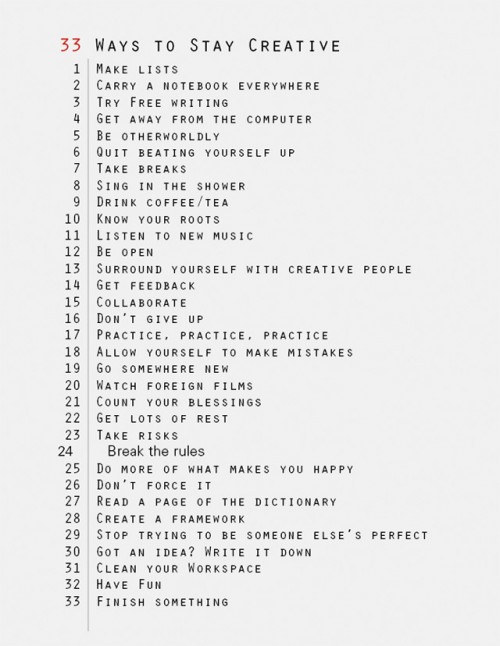
33 Ways to Stay Creative

Tags

, , ,

Just a quick one to assure you I am still alive, just adjusting all over again to how to fit homework in with everything else. I borrow tonight’s list of creativity tips from http://www.theworldsbestever.com, a fun and bizarre assortment of inspirations and oddities. A skim down the home page gave me photography, a clock, Lindsay Lohan, hot sauce, striped Oxford shirts, Guns ‘n’ Roses, and cartoon spheres arguing about culture. Quite the grab bag, and while I doubt any one person will enjoy everything, it’s neat to see the sheer breadth of what creativity can offer. Right now, on breath-catching breaks between assignments, I’m reading over:

I’m working on numbers 6 and 33 in particular tonight, trying to remember to 32, and hoping some 9 is in my future. Next up: planning a book!

Coming Home to Books

Tags

, , , ,

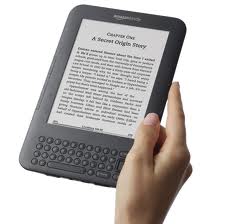
If you follow the idea of an e-book revolution through to the end, it’s possible to imagine a house where this is the bookshelf:

My New Yorkers are in a virtual pile now

Even though I love my Kindle (and really need to read those New Yorkers one of these days), the thought of only having an e-reader for my book collection makes me uneasy. Like many book-lovers, I’m attached to the physical form, and I’ve often had a hard time explaining it. Once someone tells you they don’t find the smell of musty paper and glue delectable, your main card’s played, right?

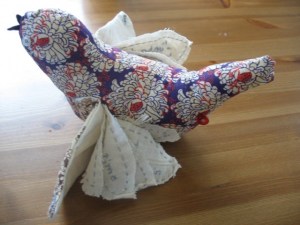
Enter Literary Publications, one of my classes this semester. We are focusing on books that are so beautiful that they become a work of art in and of themselves–and we’ll be learning to make our own! For a taste, here’s a book the professor made that she brought in to show us:

A very unusual book made by Jenny O'Grady. Love the wing "pages."

The wings have poems sewn into them about migration–one wing for the trip north, and the other for the trip south.

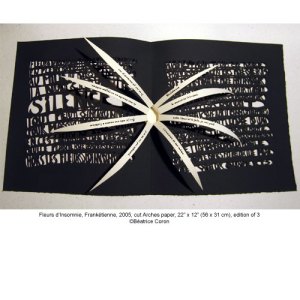
The idea of homing in on books is a happy one. In my apartment, my TV shelf has all kinds of cubbies in it for knickknacks or DVDs. Most of the cubbies have at least one book–paperback dystopian novels, the lovely green fabric-bound photo album that holds my trips to Nain and Spain, and writing books. My bedroom holds my poetry collection (2 dozen books and counting), picture books from my childhood, old copies of Jane Eyre or The Pickwick Papers, short story collections bought on a whim, and a teetering stack of library books by my bed. What I can’t wait to do is add my own creations to this collection, books that are as sculptural as literary. Check this out:

Fleur, by the amazing Beatrice Coron

The assignment this week? Make a “magic book.” Looking at book artists like Beatrice Coron, Laura Davidson, Susan Kapuscinski Gaylord, and Dineke McLean, I’m wondering if there’s anything but.

Why I’m an English Major Reading Science Books

Tags

, , ,

One of the best classes I took in undergrad was an interdisciplinary seminar on science and science fiction. We read Orwell, Huxley, Atwood, and Gibson, watched movies like Brazil and Dr. Strangelove, and a handful of times during the semester, the English professor who led the class stepped down and had a different science professor talk about his or her field. It was amazing because we got to remind ourselves that the traits we loved in ourselves as readers and writers (curiosity, imagination, the desire to tinker beyond the world we knew) are the passions that drive scientists, too.

Flash forward several years and a graduate program, and I’ve fallen completely out of the habit of the interdisciplinary approach. Grad school concentrates; I don’t even have more than one or two literature classes because we’re focusing so intently on writing and publishing. That kind of immersion has its benefits, but lately I’ve been catching myself wondering, “What am I good at? What do I know about, besides the structure of a story?”

There’s no excuse for a writer not to know something about science. There’s no excuse for a scientist knowing nothing about art. There’s no excuse for a photographer not to understand math (“graph” is in the name of their profession, for crying out loud). Animals and atoms and poetry and music and numbers and psychology and dancing and history and stars and tomatoes and everything else you’ve ever seen or heard of in your life belongs together. (Except politics. Eff that.)

This doesn’t mean be an expert in everything, and it doesn’t mean spend five minutes every day dabbling in every discipline you can think of to check them off. It means that when you find something you love, you need to at least consider how other topics might fit into it.

I’m taking a quick break from fiction and getting my nose into some different things. First off is the 2011 edition of Best Science Writing. I’m reading a lot slower than I’d like, but I love the newness of what I’m reading–the influence weathermen have over whether we believe in global warming, or a mistake researchers made when studying estrogen supplements and why they have to start over. I feel like I’m peeking over a fence, and I’m trying to remember that the fence is something I only made up because I thought I was supposed to.

What are your reading (or thinking) ruts? How do you break out of them?

Kick in the Pants

Tags

, , ,

I’m working on taking time every day to work on this story, even if I’m tired. I didn’t get myself out of bed to go to the gym this morning, but I am going tonight, and as soon as I get back, probably even before I jump in the shower, I’ll get another session in with this story to make it better. I have until the end of the month and then we’re on to the next one, so I’ve got a week to get it as polished as I can.

Scissors Beat Paper

Tags

, ,

One of the fundamental rules of life is that scissors beat paper. Another is that scrolling is a bitch. Put them together, and you have the obvious solution to one of my biggest pet peeves in editing.

Putting a story together when you’re in the early stages can be a lot like putting together a puzzle that’s gotten mixed up with another box. In the beginning, there are bound to be scenes or scraps that don’t fit with the larger picture of the story, and it’s about as likely that other parts will be missing. So what is a writer to do?

Cut the thing up, of course! I started applying scissors to my work in college, on an essay I was writing about the year I spent half of Easter break in the Netherlands and half in Spain. I was having a terrible time trying to balance the parts and figure out how to splice the stories. In a fit of desperation, I printed it out and took a pair of scissors to the thing, and I realized that it was a lot easier to physically shuffle sections of my story around than cut and paste virtually.

The story I’m working on now doesn’t hop between places, but there are a lot of elements going on–a pregnancy, disease, the question of what to do with aging parents, an adult sister with a beloved baby doll, the question of how a family is supposed to come together when all its members begin creating separate lives. Some of it is more front-and-center, some of it may not even get an overt mention, but I believe in the importance of knowing more than you tell. I’m still working on what needs to go in and what needs to stay out, so I’ll be cutting my story up and spreading it over the living room floor.

What are your editing tricks?

Is There Such a Thing as a Good Rejection?

Tags

, , ,

I think I’ve set a new record for first nibble and rejection of the year!

I was on Craigslist the other day, trolling around to see if there were any interesting freelance writing projects. As I do every year, I’ve resolved to get more involved in submitting work (in 2011, I even saw publication of a few articles at http://www.dumblittleman.com. Unpaid, but incredibly encouraging). The writing gigs were the usual calls for erotica or lazy ghostwriting to the tune of “I have a lot of GRAET IDEAS and now olny need a telented writer to help me put pen to paper haha. No pay up front but youl;l get a portion of the AMAZING ROYALTIES that will surely come!!!!!” So I checked out creative gigs, and lo and behold, a new writer wanted someone to put together a cover for her forthcoming YA ebook. I’m not going to lie and tell you I’m an amazing designer, but since she was asking for someone who knew how to use photoshop, and since I’ve taken Book Design and E-Publishing courses at a graduate school level, I figure I’ve got some modest chops. So I emailed her.

The author told me a little about her story and said that unfortunately, she couldn’t afford to pay much for the design. To be fair, it’s Craigslist and I’m new, so I said her price was fine. I then told her what I’d offer for it: a cover design and minor revision (changing font/color/photo filters, but not redoing the entire design). That’s when things went downhill.

In her reply, the author said that the design process would have to be “trial and error” and that she could “make no promises” about how many revisions she would need. And at that point, I had to make a choice. If I’m interested in freelancing, I need to take on jobs, and there are plenty of stories from pros where they took whatever they could, whenever they could, for whatever price until they got to the top. If I cared about myself, though, I had to put more value on my time than promising to do whatever it took until the unspecified day when my client was happy.

In the end, I wrote her a response saying that freelancers work off of specific contracts, and promised her a cover and two revisions, with extra revisions at an additional price. She passed on my offer, I wished her well, and I find myself feeling better about this than if I could have written here saying I’d landed a freelance job. I may have been rejected, but I gained confidence in my ability to set my own standards for what I deserve and what I can offer in my work, and I’ve learned that I won’t compromise my sanity for some extra cash or a little experience.