• Bio
  • Contact
  • Events and Resources
  • My Writing

Jessica Jonas

Jessica Jonas

Tag Archives: writing

What Are Your Rules for Writers?

14 Friday Sep 2012

Posted by jessicamjonas in Writing

≈ 6 Comments

Tags

rules for writers, writing, writing life

This week in class, we read Colson Whitehead’s smart and often hilarious advice on How to Write. Based on that, I put together my own list of rules. They’re personal, based on what works for me and the traps I struggle to avoid, but I wonder if some of them might be more broadly applicable as well:

  1. Resist the urge to summarize. Writing should move forward. Summaries, at least in my experience, all too often are safety cushions against a braver ending.
  2. Start with what you know. Fiction by definition wouldn’t exist without improvisation and exploration, but it’s equally essential to ground a story somewhere. Emotions are good starting points.
  3. Never show anyone your first draft.
  4. You know what, don’t even talk about the story until draft 3. It’s so fragile in the early stages. Volatile, too. Anything you say about the story may well be better than anything you’ve written down so far, and you won’t remember it later.
  5. Write the part of the story you’re excited about first, regardless of whether you’ve written it yet.
  6. Be flexible, both inside and outside of the story. Write Every Day only works until the first case of food poisoning. Make rules you can stick to, and don’t write drafts so rigid you can’t follow a better idea.
  7. Have fun with revising. Cutting a story up with scissors is a good way to quickly try out new scene arrangements and keep in touch with the fearless inner kindergartener at the same time.
  8. Write scenes that aren’t even supposed to be in the final version for the sake of getting to know the characters better.
  9. If it’s in because it makes you feel clever, it probably shouldn’t be in.
  10. Writing in any subgenre has the potential to be literature (here’s to you, spec fic).

What writer’s rules do you swear by?

Writing Update

13 Thursday Sep 2012

Posted by jessicamjonas in Goals, Writing

≈ Leave a comment

Tags

writing, writing life

It’s all about getting your butt in the chair, whichever way you cajole, trick, threaten, or bribe your way in, right? The first week and a half of the 1,000-minute goal is overall going well. Here’s what I’m learning so far:

  1. Time adds up. Whether it’s a 40-minute blast or four 10-minute nibbles throughout the evening broken up with dinner, Internet browsing, and writing bridal shower thank-you notes, I’m spending the same time writing. Mostly, it even seems I get about the same amount of writing done no matter how I split, which is key.
  2. Concentrating my efforts is good. So far this month, I’ve spent just over 5 1/2 hours writing, almost all of it focused on one story. I’ve been through the draft twice and there’s barely a paragraph I haven’t changed at least once. The result? When Andrew read the new version, his response was “I finally understand what’s going on with these characters!”
  3. Boredom is a tool. It’s easy to claim lack of inspiration as an excuse not to write. The truth is, every single time I’ve scrolled to a part of the story I disliked, put my hands in my lap, and waited, it was a matter of about 5 minutes before I thought of something I could do to make it better. Your brain wants to be entertained. I bet you a pile of dollars that if you set a timer for just about anything above 10-15 minutes, resolutely ignore the Internet, and stare at the blank page, your brain will have something to put there before the end of that time.

I will confess I’m slightly behind on my minutes goal at the moment, but what I’ve learned from NaNo is that there’s a point near the middle of large goals where the novelty wears off and a bit of sliding happens. The key is not taking a slide as a failure. There are plenty of opportunities to catch up, and given how productive this challenge has been so far, I’m determined to keep at this.

Making Time to Write: A New Approach to Quotas

04 Tuesday Sep 2012

Posted by jessicamjonas in Goals, Writing

≈ 2 Comments

Tags

making time to write, writing

I have an on-again, off-again relationship with a routine writing practice. I’m good in spurts–I’ve successfully reached the 50,000 word mark in three NaNoWriMo Novembers–but the rest of the year is a puzzle to me.

Many writers do well with daily word quotas, and for about 8 months during my senior year of college, I did, too: 500 words a day, every single day. I liked the predictability of it and the fact that I could feel it getting easier. The first day took something like two hours. Later on, I could knock out my words in under 30 minutes on a good day.

What went wrong was that I didn’t have a way to account for editing. I was obligated to produce those 500 words, but what if I was editing a scene? I might write a paragraph or so, change some words, but a large part of my editing involves playing with order, deleting, and doing exercises to probe into areas of the story I’m missing. An hour’s solid, productive editing might result in 200 actual words entered onto the page. I couldn’t find a good conversion for what 500 words of writing “equaled,” so I fell off the wagon.

I’ve also tried daily writing schedules–15 or 30 minutes a day, usually. I’d get up early in the morning or set aside some time in the evening, and for a few weeks it would go well, until I got sick or had a terrible day and skipped. I’m motivated by goals, you see, but I’m also very hard on myself when I don’t meet them. After midnight, those 15 minutes are gone forever and I have a permanent black mark on my record.

What I need, I am learning, is a goal to push toward that will also allow flexibility. My goal should account for my life: the fact that I have new-found weekend time after quitting my job at the church, but that all I want to do when I get home after class is relax. I’m strong and focused on Mondays, drained on Fridays. I need to break away from the idea that if I can just be disciplined enough, I can make every day feel the same.

What I’m trying this September is a monthly goal: 1000 minutes of writing. It comes out to an average of about 35 minutes a day, challenging but achievable, and I can use weekends to my advantage to gain time in case I need a breather. It’s not quite a daily goal, although if I know what’s good for me I’ll be butt-in-chair at least 6 days a week! I’m currently at 118 minutes, and I’ve been excited to see how much gets done in each session. It’s been nice to be able to choose a 40-minute power stretch or 15-minute bursts separated by lunch with Andrew or a long walk.

Of course, I’ve learned over the years that writing goals and needs change, sometimes unexpectedly, and that part of learning to write consistently is learning when to fight the impulse to do something else and when to listen and adapt. For those who are struggling with a consistent daily routine or word-count quota, I’d recommend trying out a weekly or monthly goal instead.

On Graduating and Chasing Chipmunks

25 Friday May 2012

Posted by jessicamjonas in Goals, Growing Up, Writing

≈ Leave a comment

Tags

abandoning perfectionism, graduation, setting goals, writing

This week, my fiance and my sister graduated back-to-back, earning a Masters and two Bachelors degrees, respectively. Clearly, I am incredibly fortunate to be part of a family that kicks academic butt. I am so proud of them.

One moment in the speaker’s address for the Masters commencement caught my attention. He was praising the graduates for their innovation and perseverance, and urging them to dream as big as possible, and he said, “Do you know why a lion doesn’t chase chipmunks? He knows if he does, he’ll starve to death.”

My first reaction was wow, that makes a lot of sense. Pouring my time and energy into busywork is a great way to burn myself out without accomplishing anything I’m proud of or receiving a sustainable reward. It’s the reason I don’t write $5 content mill articles. It’s also the reason I tend to let the apartment get messy when I’m working on a midterm project or trying to finish NaNo–having a clutter-free coffee table is nowhere near as important as polishing my short story.

But then I started thinking about a conversation I recently had with my supervisor, Teresa. She told me the story of a freelancer we work with–the freelancer timed her switch from a 9-5 to freelance life poorly, leaving her company when another member of her team was on maternity leave so that the company ended up feeling forced into a corner to work with her freelance  because they didn’t have the in-house resources to cover her work while they found someone new. The freelancer also apparently asked to be paid a steep hourly rate–nearly twice what Teresa’s encountered other, more experienced freelancers charging. Her company cut her off as soon as they could. Our company still works with her, so I guess that’s a sign that being a little pushy can get you what you need, but she comes off as greedy and a little underhanded in how she went after her goal.

Working for goals too small can kill your spirit.

Setting your goals too high can cross the line from assertiveness into entitlement, or can leave you with nothing at all.

I’m only 3 years postgrad myself, so I am still figuring things out. It occurs to me, though, that although the lion will die if he only eats tiny chipmunks, he won’t be any better off only trying to catch the strongest, fastest antelope. And in fact, by claiming the older or weaker animals, the lion not only satisfies his hunger without working to exhaustion, but strengthens the herd.

So my advice this year for graduates is this: Know what kind of animal you are. Know what you need to fuel your goals and do not underestimate or cheat yourself from going for what inspires you. But don’t undervalue the ones around you, either. Creativity, passion, drive, and innovation reach far enough to benefit more than one.

Who’s Your Ideal Reader?

21 Tuesday Feb 2012

Posted by jessicamjonas in Reading, Uncategorized, Writing

≈ 2 Comments

Tags

good readers and writers, ideal reader, nabokov, writing

In International Fiction this week, we’ve been reading a (tiny) sample of Russian writing, including Nabokov’s wonderful essay, “Good Readers and Good Writers.” One of the class writing prompts was to take a page from Nabokov and consider who our ideal reader would be. It’s an eye-opening exercise that I would recommend to any writer. I realized I had a more specific experience in mind than I thought I did when I daydream/hope about how someone will feel reading my work. My thoughts are below. Tell me about your imagined reader in the comments!

My ideal reader, first and foremost, would have to be fascinated by people. This is partly just on the surface level: As a writer, I am primarily interested in people and relationships, and details like place and appearances get filled in later, if at all. Even plot is more or less a peripheral element for me; it’s a vehicle to bring people into the situation where they will reveal themselves. If my reader isn’t interested in people, he or she isn’t going to be my reader for very long.

My reader, as a person, would be sensitive and imaginative and would see reading as a collaborative exercise. I have a hard time right now gauging how overt or subtle my stories are, but I value subtlety. I like subtext. I like writing a conversation where you can hear the echo of another conversation underneath in what isn’t being said, and it takes a sensitive writer and reader to know how to approach such a conversation so that those echoes materialize. I like to explore gestures. I don’t often tell as much as I maybe should about my characters’ clothing or hair or eye color, but I like my reader to know how they move, because I think body language is the easiest way to read someone’s mind. Maybe that’s because I am a fidgeter with a wide range of tics. My reader would have the sustained imagination to see my character in movement throughout the story, and the sensitivity to see the shifts of emotion in the changes in gesture and the cues in conversation. I would want my reader to temporarily become my characters (rather than relate to them), which is why it would be important for my reader to have a spirit of collaboration. It would ideally be almost like an actor doing a study of a character he or she was going to play, getting rid of his or her innate patterns and taking on a new persona to understand a life through a different lens.

The other reason I want my reader to love people is that I want him or her to be so consumed that “person-ness” goes beyond humanity. I want my reader to leave my writing thinking of my story as a kind of person. I don’t mean thinking of the characters as “real,” although that is an element of what I’m envisioning. I think a really good, well-written story ends up having a mood and an idea and a manner of expression that blend together and form a personality. That is why I reread books I love, and why I would want readers to come back to my stories: the story itself becomes someone you want to spend time with. I sometimes pick up particular books when I’m troubled about something, not because the content or plot has a lesson I need, or the book features a character going through my problem, but because the whole story itself has a personality of probing, curiosity, reproach, authority, encouragement, or inspiration that touches something in me.

Ray Bradbury wrote in Zen and the Art of Writing that you should read poetry every day even if you don’t understand it on any level you recognize, because your ganglion will understand. Sometimes when I am in those troubled moods I will read on autopilot and end up talking out loud to the book, saying, “yes, I know what you mean,” or, “but how do I get there?” and it’s because my ganglion is in conversation with the personality of this particular book.

When I was little, I called certain favorite books of mine “oatmeal books.” They weren’t about oatmeal, and didn’t necessarily share a theme or style, or any other characteristic other than the emotional response they brought out in me. I absolutely could not articulate what I meant by that when I was a kid, and it’s hard even now, although in my head I know precisely what I mean. The closest I can get is to compare it to that moment of resonance other people have described, of the thrum of finding a story that works so well that it makes you feel like an extension of it. As a child, I probably picked the word “oatmeal” thinking intuitively of something with warmth and weight, but it also had an element of the inevitable and necessary. When it was a winter morning, you were fundamentally entitled to a bowl of hot oatmeal, as a human being. When I hit that certain reading mood, I would have ripped the house apart to find one of my oatmeal books. I craved this kind of reading experience as intently as any physical need, and when I had it, I was enveloped in a state of complete peace and comfort, even if the book was sad, because I had connected with the exact right book. The ideal, of course, would be to create something like that.

My Proud Moment This Week

17 Friday Feb 2012

Posted by jessicamjonas in Writing

≈ 6 Comments

Tags

making time to write, writing, writing life

It’s been a busy week. I’m taking on another big book at work and copyediting it myself. It’s cool because the book is about neuropsychology, which is at least tangentially in my field (Media Culture was half psychology). It’s stressful because the book is over 1100 pages and it’s on a tight turnaround. Today was mostly editing references.

Sometimes I have weeks where I feel like I’m getting lots done, but not going anywhere. Today would have been one of those weeks. I can dismiss what I do during the day job as being a separate category from the personal goals I set for myself. I haven’t been to the gym in weeks because I’ve been exhausted, and it’s frustrating to think I’m at least appearing to be the out-in-February failed-resolution crowd. I got the last piece of homework done in class as the professor was setting up.

But what I’m really proud of is that even if a lot of other things felt rushed or missing this week, and even if it was only one day, I wrote this week. Even though I was tired last night, I ended up finishing some homework early, so I pulled up my story, and made it to the end. It’s not as bad as I thought it would be, either. There are some vague moments that could get teased out more and a paragraph or two that I’m not sure I’ll keep, but I like the concept of it and the way my experiment is paying off. It’s my little triumph of the week, finishing an edit on that story, so even though my shoulders are sore from sitting in this office chair all day, I am feeling good, heading into the weekend.

Reading for Writers

13 Monday Feb 2012

Posted by jessicamjonas in Books, Writing

≈ 10 Comments

Tags

dorothea brande, inspiration, natalie goldberg, peter bowerman, william zinsser, writing, writing life

A friend of mine contacted me the other day because she’s interested in getting into writing more seriously and wanted to talk about how to get started. It was wonderful because it’s always an ego boost when people think you’re good enough at something to ask for your thoughts, and because having lunch with a friend and talking about books and writing sounds like an ideal way to spend a few hours of a Saturday afternoon.

I was putting together some recommendations, books and blogs and magazines that have helped shape my understanding of what being a writer means, so it only seems fair that I would share them here:

The Books

  1. On Writing Well, by William Zinsser. One of those perfect books on structure and craft. His focus on clarity, strength, and confidence in writing is as applicable to poetry as nonfiction, copywriting, blogging, or novels.
  2. Becoming a Writer, by Dorothea Brande. An oldie, originally published in 1934. This book addresses “personality problems” like writer’s block, how to balance reading well and writing well, developing a writing schedule, and so forth.
  3. Bird by Bird by Anne Lamott and Writing Down the Bones, by Natalie Goldberg. A Zen follower and poet, Goldberg is a legendary writing guru. Her writing philosophy combines deep introspection and moment-by-moment awareness in a writing style that feels to me like creative meditation. Anne Lamott’s book is named after a memory of her brother panicking at the thought of tackling an overwhelming ornithological project. Her father’s advice, “Just take it bird by bird, buddy,” is perfect for novelists working to break past the “Chapter 1–now what?” hurdle.
  4. The Well-Fed Writer, by Peter Bowerman. Because being a starving writer in a garret isn’t half as romantic as it seems (and it doesn’t even seem that romantic). Bowerman delivers practical tips for starting and running a lucrative freelance writing biz. His lively, engaging voice is like having a session with a career coach, no-nonsense and encouraging at the same time.

The Magazines

  1. Poets & Writers (more literary)
  2. Writer’s Digest (more commercial/consumer magazine)
  3. The Writer (excellent for beginners, has the most articles on developing writing skill)

The Blogs

  1. Carol Tice’s http://www.makealivingwriting.com (freelance how-tos)
  2. Ali Luke’s http://www.aliventures.com (fiction and creating a strong blog platform)
  3. Copyblogger’s http://www.copyblogger.com/blog (copywriting and blogging)

Which writing books, blogs, and magazines do you find most helpful?

The Publishing Fetish

09 Thursday Feb 2012

Posted by jessicamjonas in Books, Reading, Writing

≈ Leave a comment

Tags

italo calvino, lightness, publishing, quickness, six memos, writing

“The demands of the publishing business are a fetish that must not be allowed to keep us from trying out new forms.”

The quote comes from Italo Calvino’s Six Memos. I’m reading two of them this week, “Lightness” and “Quickness,” and they are both gorgeous explorations of qualities of literature and writing that Calvino enjoys, or notices in himself, or wants to develop more. Neither term is as simple or frivolous as it may seem on first glance, and I’d like to get into Calvino’s ideas a little bit more, but first we need to talk about that quote, because it’s incredibly important.

As people keep explaining, the emergence of e-publishing and the traction it has gained in the last several years marks a kind of revolution in the relationship between writing and publishing that we haven’t seen in decades, if ever. In a time where only a tiny percentage of literary journals pay for stories and poems, only a fraction of consumer magazines publish literature, and traditional publishing seems more and more steeped in bureaucracy, the fact that writers are able to publish their work independently, and to do so with decreasing stigma, is a wonderful movement toward the empowerment of literary thought and talent.

What it is key to remember, though, is that independent publishing is still, ultimately, part of the publishing business. I say this because if a writer publishes traditionally and is discouraged from breaking out of his or her genre, or trying a new form, it’s fairly clear that whether the publisher or agent or whoever is to blame for imposing restrictions. If a writer is working independently, it’s going to be harder to tell whether reluctance to try a new thing, or pressure to do one particular thing, is in response to the writer’s own voice or his or her perceived publishing rules.

We are exploring a new publishing frontier, and as with any unsettled space, what we will find is what we bring with us. We can make a world with the same shelves and distinctions, or we can reinvent them. Length doesn’t matter anymore—without the dependence on paper signatures or the need for a hardback book to meet a certain length in order to balance text and cover, we can see more novellas, or short stories published as singles—or even epics that would have been too much for a spine to handle. When you don’t have the barrier of a magazine’s or publishing house’s reputation to consider, we could have more experimental fiction. We could see a writer publishing the bizarre along with the traditional as versatile, not uneven.

Many writers are undoubtedly already taking this philosophy to heart without needing me or Calvino or anyone else to remind them. I’ve been noticing a number of online literary magazines asking specifically for the experimental and new. For a lot of us, though, myself included, it’s still so easy to get wrapped up in the publishing fetish (Calvino’s choice of word there is perfect), and it’s important to get the reminder that if we think we can do something well, sooner or later, there will be a need and an audience for our kind of writing.

33 Ways to Stay Creative

06 Monday Feb 2012

Posted by jessicamjonas in Writing

≈ 3 Comments

Tags

creativity, inspiration, when the writing isn't happening, writing

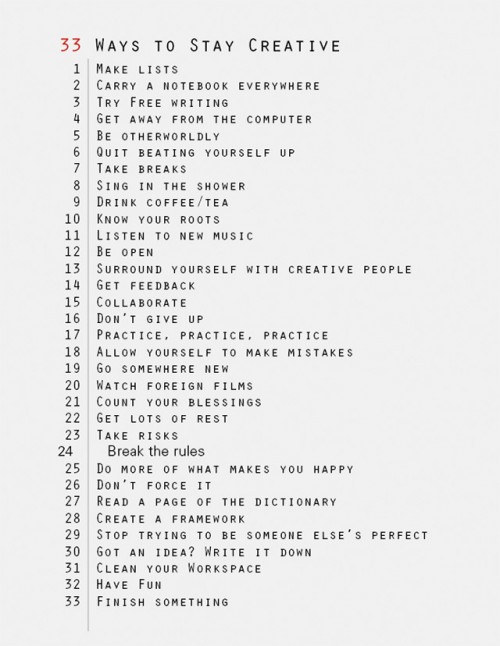
Just a quick one to assure you I am still alive, just adjusting all over again to how to fit homework in with everything else. I borrow tonight’s list of creativity tips from http://www.theworldsbestever.com, a fun and bizarre assortment of inspirations and oddities. A skim down the home page gave me photography, a clock, Lindsay Lohan, hot sauce, striped Oxford shirts, Guns ‘n’ Roses, and cartoon spheres arguing about culture. Quite the grab bag, and while I doubt any one person will enjoy everything, it’s neat to see the sheer breadth of what creativity can offer. Right now, on breath-catching breaks between assignments, I’m reading over:

I’m working on numbers 6 and 33 in particular tonight, trying to remember to 32, and hoping some 9 is in my future. Next up: planning a book!

Why I’m an English Major Reading Science Books

25 Wednesday Jan 2012

Posted by jessicamjonas in Breaking Boundaries, Reading

≈ 6 Comments

Tags

interdisciplinary, reading, science, writing

One of the best classes I took in undergrad was an interdisciplinary seminar on science and science fiction. We read Orwell, Huxley, Atwood, and Gibson, watched movies like Brazil and Dr. Strangelove, and a handful of times during the semester, the English professor who led the class stepped down and had a different science professor talk about his or her field. It was amazing because we got to remind ourselves that the traits we loved in ourselves as readers and writers (curiosity, imagination, the desire to tinker beyond the world we knew) are the passions that drive scientists, too.

Flash forward several years and a graduate program, and I’ve fallen completely out of the habit of the interdisciplinary approach. Grad school concentrates; I don’t even have more than one or two literature classes because we’re focusing so intently on writing and publishing. That kind of immersion has its benefits, but lately I’ve been catching myself wondering, “What am I good at? What do I know about, besides the structure of a story?”

There’s no excuse for a writer not to know something about science. There’s no excuse for a scientist knowing nothing about art. There’s no excuse for a photographer not to understand math (“graph” is in the name of their profession, for crying out loud). Animals and atoms and poetry and music and numbers and psychology and dancing and history and stars and tomatoes and everything else you’ve ever seen or heard of in your life belongs together. (Except politics. Eff that.)

This doesn’t mean be an expert in everything, and it doesn’t mean spend five minutes every day dabbling in every discipline you can think of to check them off. It means that when you find something you love, you need to at least consider how other topics might fit into it.

I’m taking a quick break from fiction and getting my nose into some different things. First off is the 2011 edition of Best Science Writing. I’m reading a lot slower than I’d like, but I love the newness of what I’m reading–the influence weathermen have over whether we believe in global warming, or a mistake researchers made when studying estrogen supplements and why they have to start over. I feel like I’m peeking over a fence, and I’m trying to remember that the fence is something I only made up because I thought I was supposed to.

What are your reading (or thinking) ruts? How do you break out of them?

← Older posts
Newer posts →

Enter your email address to subscribe to this blog and receive notifications of new posts by email.

Join 355 other subscribers

The Latest

  • Prices to Pay
  • Why You Should Do NaNoWriMo This Year
  • Back in the US!
  • Hiatus
  • The Briefest of Check-Ins and Some Words About a Bride

Journal History

  • February 2015
  • October 2014
  • September 2014
  • January 2014
  • August 2013
  • July 2013
  • January 2013
  • December 2012
  • November 2012
  • October 2012
  • September 2012
  • August 2012
  • June 2012
  • May 2012
  • March 2012
  • February 2012
  • January 2012
  • December 2011
  • November 2011
  • October 2011
  • September 2011
  • August 2011
  • July 2011
  • June 2011
  • May 2011
  • April 2011
  • March 2011
  • February 2011
  • January 2011
  • December 2010
  • November 2010
  • October 2010

Recurring Thoughts

abandoning perfectionism annoying art Banned Books Week birthday blogging book design books canary review class criticism D.C. elephants engagement epic bosshood essay fiction flash fiction flash friday goals grad school Hunger Games inspiration italo calvino jose saramago judaism lauren winner literature love magazine writing making time to write memoir mfa mudhouse sabbath nanowrimo niche markets nobel prize novel obama oddities oedipus paul guest pie poetry politics progress publishing quarterly review reading religion reports resolutions short stories sometimes goals are hard steps back steps forward submissions substance tanya egan gibson the apartment The Book the elephant's journey top-shelf totally boss wedding what I'm reading when the writing's going well when the writing isn't happening word count work working my butt off writer's block writing writing life YA

Blog at WordPress.com.

  • Subscribe Subscribed
    • Jessica Jonas
    • Join 85 other subscribers
    • Already have a WordPress.com account? Log in now.
    • Jessica Jonas
    • Subscribe Subscribed
    • Sign up
    • Log in
    • Report this content
    • View site in Reader
    • Manage subscriptions
    • Collapse this bar
 

Loading Comments...